What a Short Boxed Beard Is
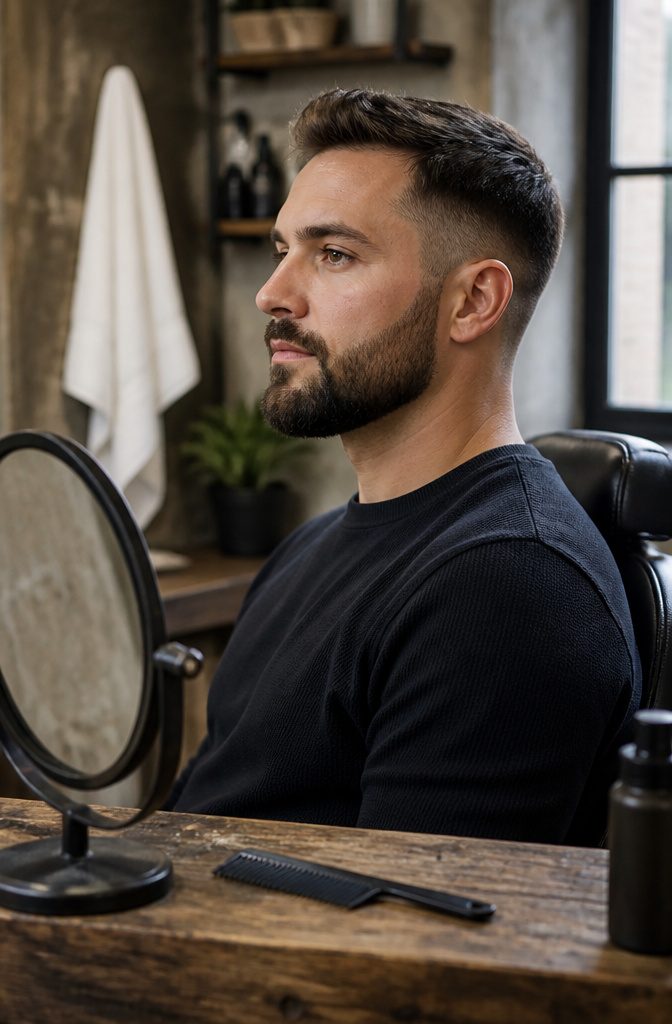
A short boxed beard is a full beard trimmed close and shaped with defined borders along the cheeks and neck.
The length sits around ½ inch (roughly 12–15mm), short enough to stay controlled but long enough to frame the jawline with actual structure.
What makes it "boxed" is the intentional geometry: sharp cheek lines, a neckline that cuts closer to the jaw than most full beards (typically an inch above the Adam’s apple), and corners that follow or slightly sharpen your natural angles rather than rounding them off.
The style follows your natural facial hair growth but trims everything to an even length and enforces crisp edges.
That’s the contrast with a longer, bushier full beard, which relies on volume. A short boxed beard relies on shape.
The structure highlights bone definition rather than hiding it, which is why it works well on angular, oval, heart-shaped, and round faces. It’s neat enough for most workplace environments without looking tentative or unfinished.
1. Grow Enough Facial Hair to Shape
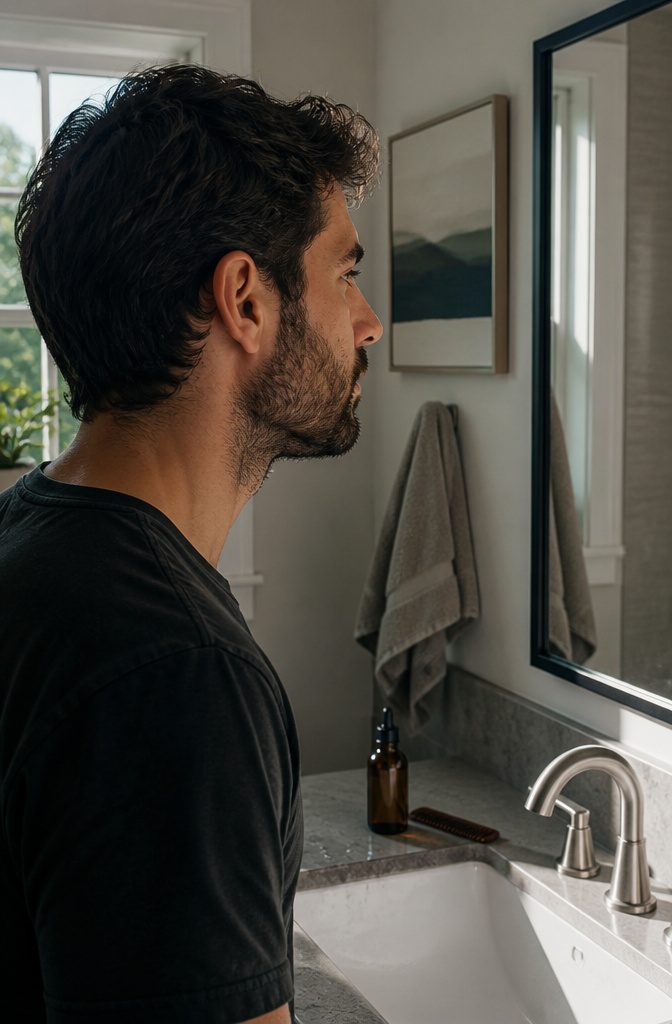
You need at least two weeks of growth before you can shape a short boxed beard, and four weeks gives you better coverage to work with.
The minimum length worth trimming is about 10–15 mm. If you start too early, you will cut too close and lose the definition the style is built on.
First-time growers with lighter or red facial hair should aim for 1–2 inches all over.
The extra length fills in patchy spots and shows where your natural density actually sits before you commit to a shape. Darker, coarser hair can get away with less.
I let mine grow undisturbed during this stage. Trimming early does not speed anything up, and every pass with clippers resets the clock.
Use beard oil if your growth is slow, but patience does more than product. You need enough length to carve clean lines without guessing where the hair will eventually land.
2. Prepare and Comb the Beard
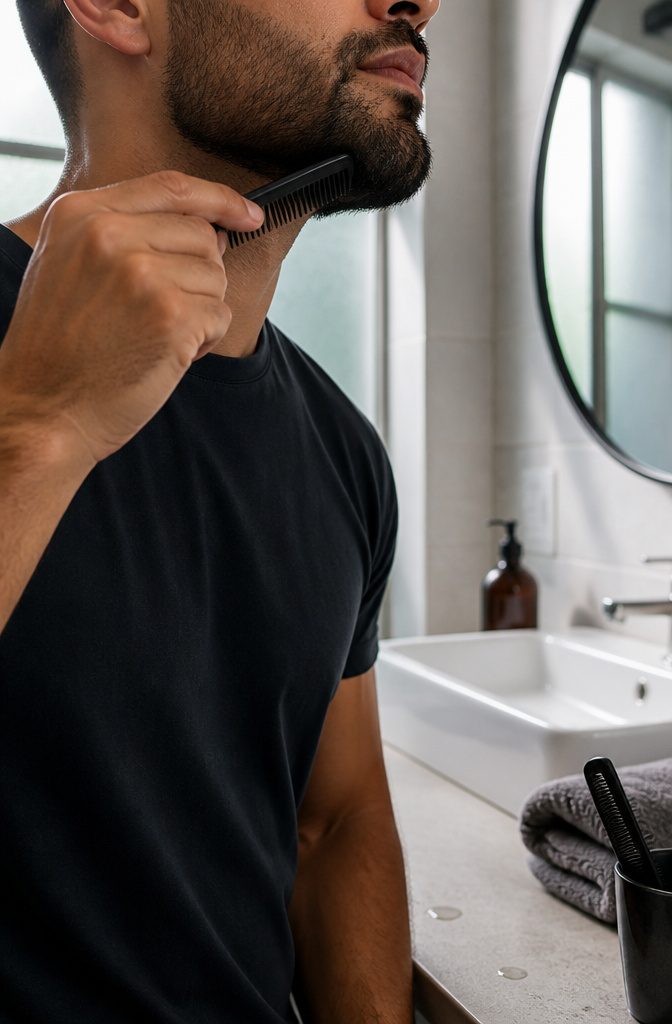
Wash the beard with warm water and beard shampoo or conditioner; the heat and moisture soften the hair so it cuts cleaner. Don’t trim straight out of the shower, though.
Wet hair hangs longer than it really is, so a line that looks even on a damp beard dries uneven. I’d let it dry completely before the clippers or scissors come out.
Then comb through in the direction of growth. That pulls out tangles and shows the beard’s true shape, which is what you’re cutting to.
If you plan to shave the cheeks and neck bare, rinse with warm water and work shave gel over those areas first. It cuts down on nicks and irritation.
3. Trim the Overall Length
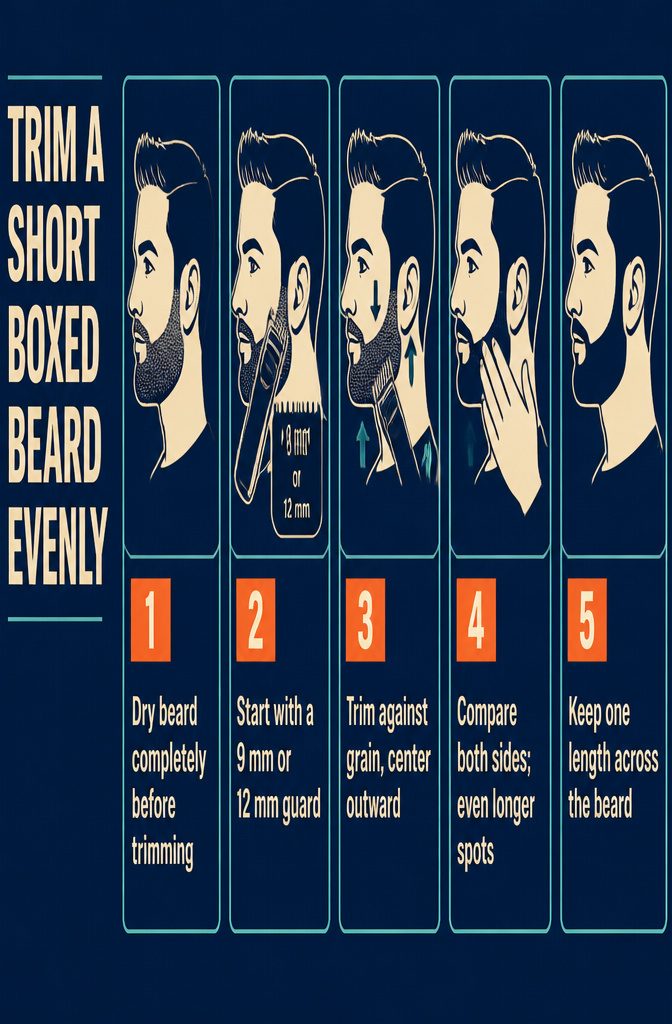
- Start with a completely dry beard. Wet hair hangs longer and cuts unevenly.
- Clip on a 9 mm or 12 mm guard and go shorter only if the beard still looks heavy. Published advice runs from 3–6 mm for a tight finish to 5–15 mm for a fuller one, and 3–12 mm covers the middle. Shorter guards keep the box crisper.
- Trim against the grain, upward on the neck and downward on the cheeks. Work from the center outward on each side, with slow strokes and steady pressure.
- Run your fingers through both sides and compare them, then go back over any spot that feels longer.
- Pick one length for the whole beard. A 12 mm chin and mustache over 9 mm cheeks adds contour, but I’d skip it here, since a boxed beard depends on even length.
4. Define the Cheek Line
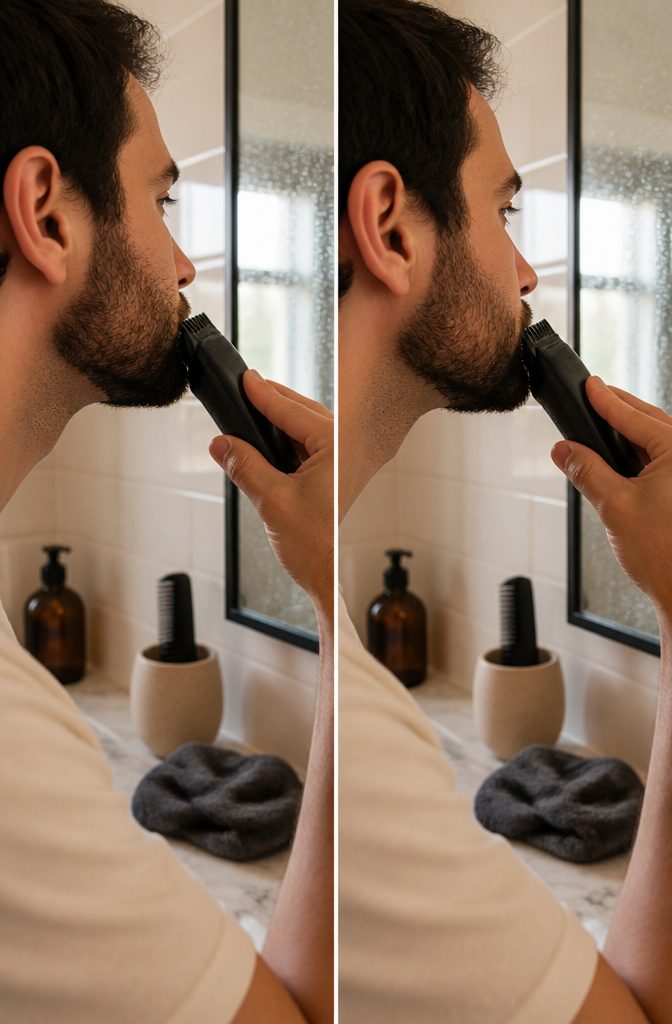
Natural growth already hints at the line, so start there. Picture a path from the top of the sideburn to the corner of the mustache, and trace it with the trimmer set without a guard.
Remove as few whiskers as possible; every hair you leave is one less to chase later.
Keep the cheek line low and slightly angled downward.
A line that creeps up throws off the box and looks uneven. I’d make a faint test pass, step back from the mirror, and nudge it up only in small steps.
Following the curve of the cheekbone is the usual slip. Your finger or a ruler works as a guide for the first few tries.
5. Shape the Neckline
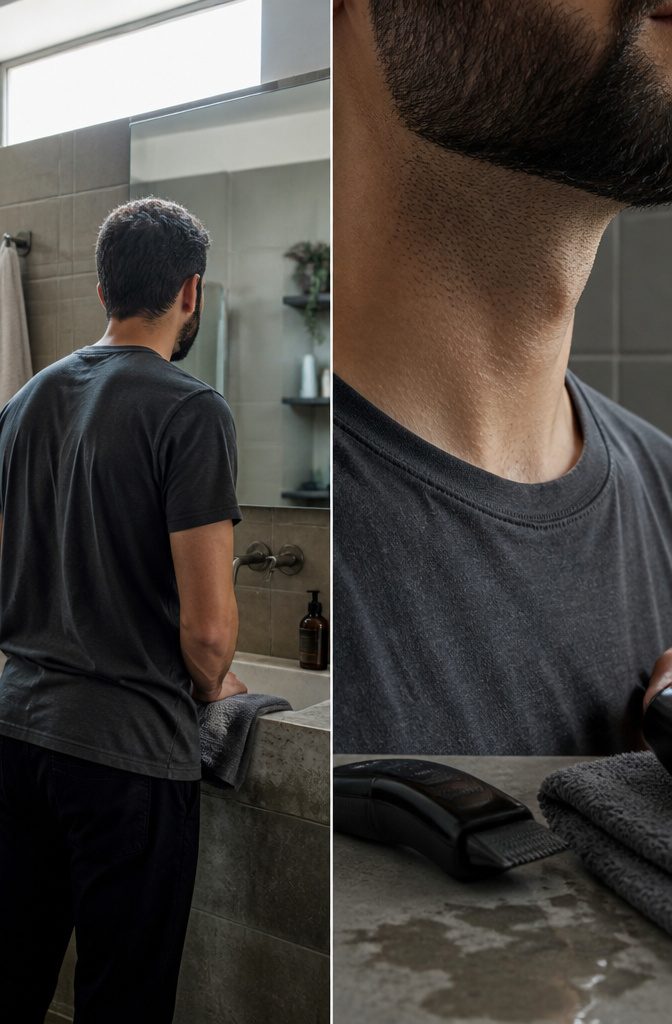
The neckline sits somewhere between your Adam’s apple and your jawbone, though barbers disagree on the exact placement.
One approach puts the line one to two finger-widths above the Adam’s apple, another lands it one to two inches below the jawbone, and a third splits the difference at half an inch below the jaw at the sides, widening to one to one and a half inches under the chin.
Tilt your head down to feel where your neck meets your jaw, pick a reference point that looks balanced when you face forward, and shave everything below it.
The line itself can run straight across, curve gently following the underside of your jaw, or form a U-shape.
A straight horizontal cut reads as stark; most barbers favor a curve or U because it follows the bone structure and looks less drawn-on.
Whichever contour you choose, keep it consistent from ear to ear and blend the edge so the shaved zone doesn’t end abruptly.
6. Create the Boxed Corners and Check Symmetry
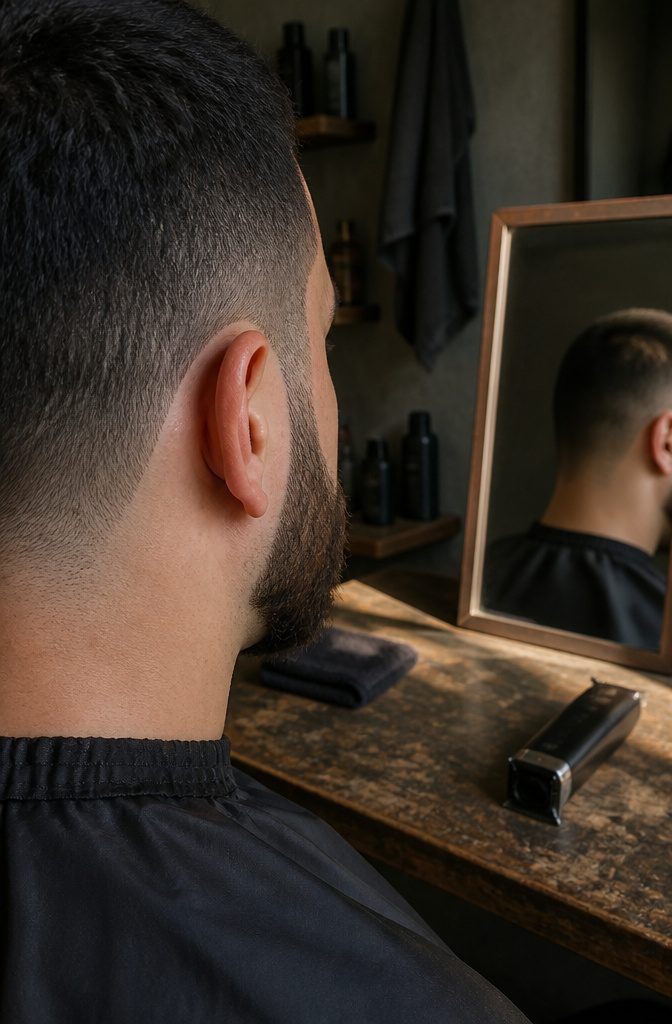
The 90-degree corner where the sideburn meets the beard is what makes the style look intentional instead of grown in by accident.
I trim the sideburns down to match the beard length first, then use a detail trimmer or razor to sharpen that corner near the ear.
The angle should read as deliberate, not rounded off. Repeat on the other side, paying attention to height and sharpness so both corners land in the same place.
Symmetry matters here, but overcorrecting while chasing perfect balance is where most trims go wrong.
I check both sides in the mirror and adjust gradually. If one corner sits slightly higher, a small pass fixes it.
Trying to force exact symmetry by removing too much leaves the whole beard shorter than planned and the lines weaker. Better to live with minor asymmetry than to keep shaving until there’s nothing left to square off.
7. Trim the Mustache and Remove Strays
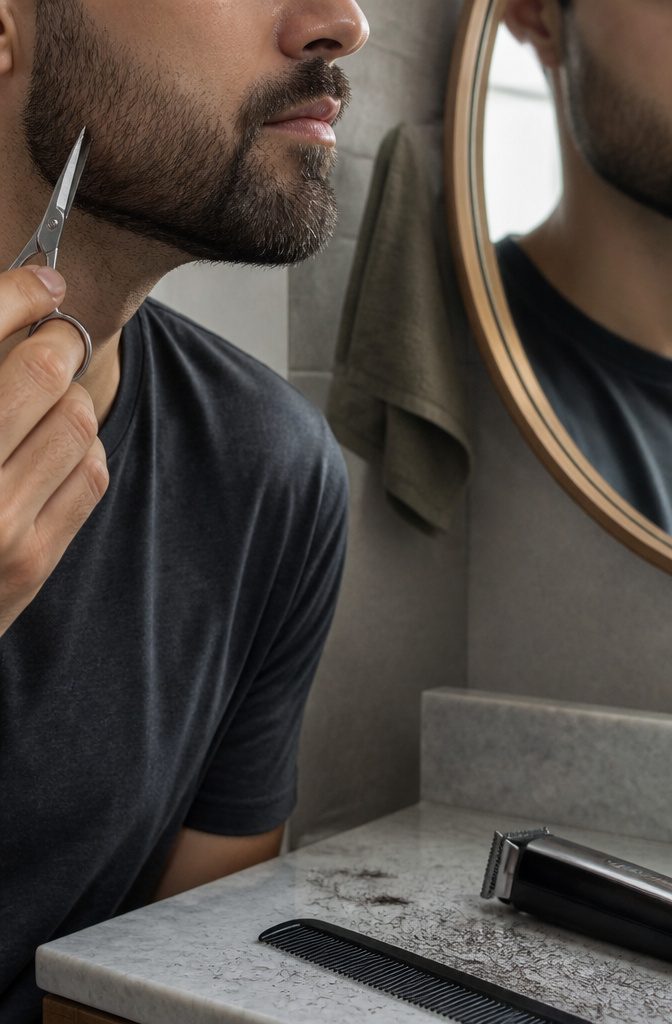
The mustache should match the beard in length or sit just slightly shorter. Hairs that hang over your upper lip break the clean look, so trim back any that cross the lip line.
A detail trimmer gives better control here than a full guard, and the work goes quickest if you pull your upper lip taut while you trim.
Strays show up everywhere once the bulk is trimmed. Look for longer hairs sticking out past the cheek line or jaw edge, and clip them with scissors rather than pulling the trimmer back out.
The soul patch and the area just under the lower lip collect oddball hairs that sit at wrong angles; tidy those the same way.
Check both sides in a mirror to confirm the mustache height matches and no long outliers remain.
If an edge looks too abrupt after trimming, pass over it once more with a guard one step longer to soften the transition without losing the line.
8. Rinse, Moisturize, and Style
Once the beard is trimmed, rinse your face with cool water to wash away shaving cream and clipped hair.
Pat dry with a towel, then follow with a hydrating aftershave lotion to keep the skin comfortable and prevent dryness or irritation where you shaved.
While the beard is still slightly damp, work a few drops of beard oil through the hair and down to the skin underneath.
The oil locks in moisture, softens the hair, and gives the beard a clean shine without looking greasy.
If you want a bit more hold or your beard leans wiry, a light beard balm does the same job with added control.
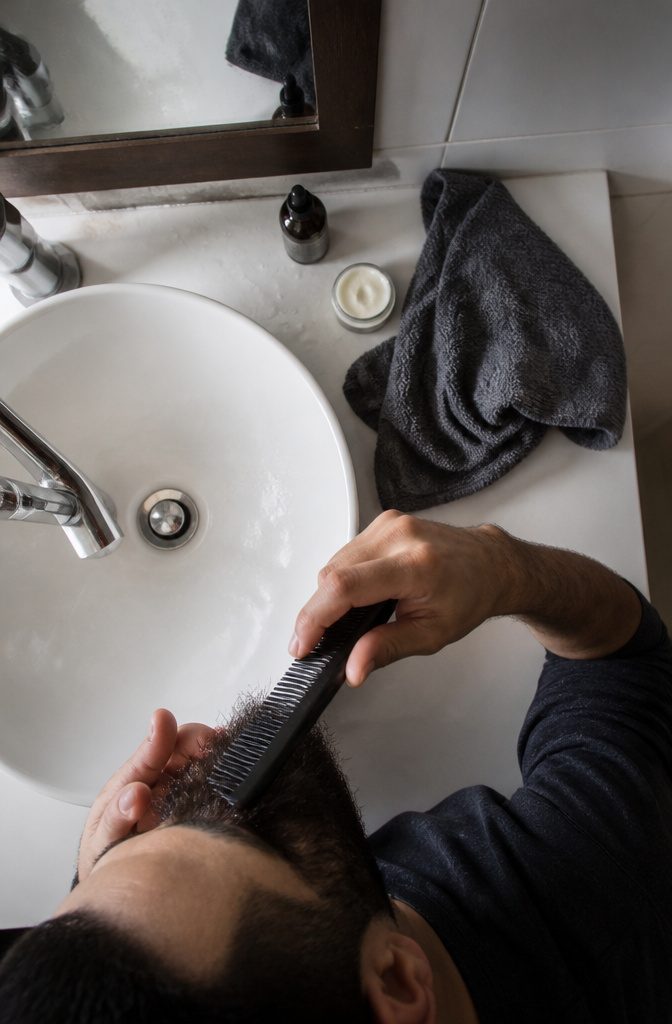
Finish by combing or brushing the beard in the direction of growth.
This trains the hair to sit the way you want it and keeps the shape looking deliberate rather than patchy. Daily combing also spreads oil evenly and catches any strays you missed during the trim.
9. Maintain the Shape
Schedules run from twice a week to every 7–10 days, and the gap comes down to how sharp you want the borders.
Twice a week, or 2–3 times, keeps the length tidy with little effort. A 7–10 day cycle only works if you add line touch-ups every few days in between.
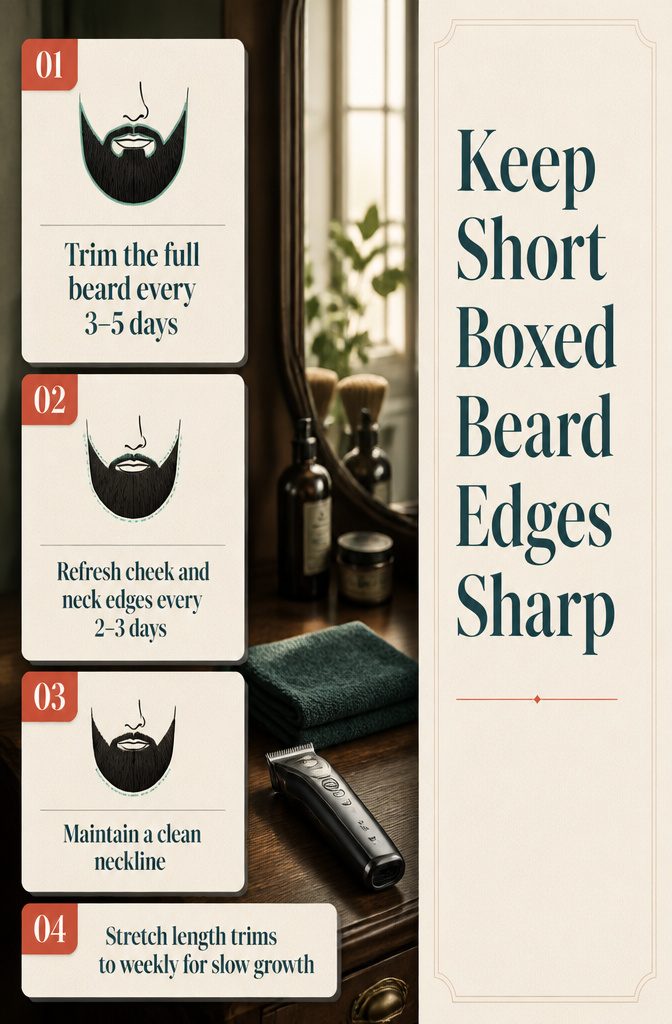
For the crispest box, I’d go with a full trim every 3–5 days and cheek and neckline edges every 2–3 days.
Slow growers can stretch the length trim to weekly, but the edges still need the attention, because they are what make the beard read as boxed instead of just short.
Length and Guard Settings
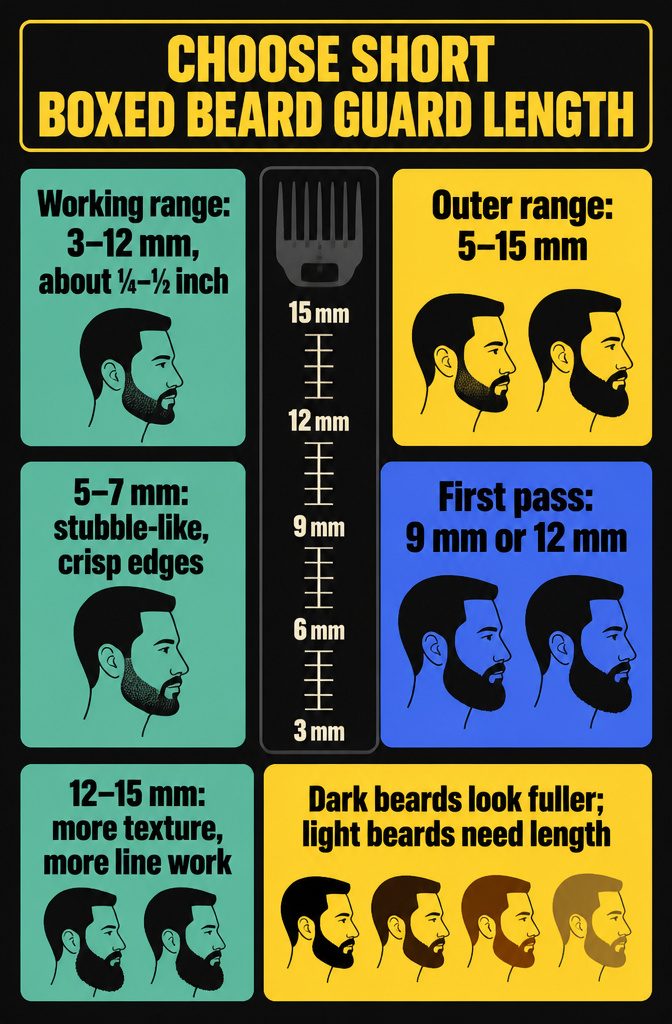
Guard advice runs from 3 mm up to 12 mm, or roughly ¼ to ½ inch, and the outer range stretches to 5–15 mm. Short settings of about 5–7 mm read close to stubble and keep edges crisp.
At 12–15 mm you get more volume and texture, but the lines take more work. My pick for a first pass is 9 mm or 12 mm, since you can always go shorter but can’t put length back.
Color and density shift the answer: dark beards look fuller at short lengths, while blonde or red ones need a little more length to look filled in.
For subtle contouring, run 12 mm on the chin and mustache and 9 mm on the cheeks and neck.
Face Shapes That Suit a Short Boxed Beard
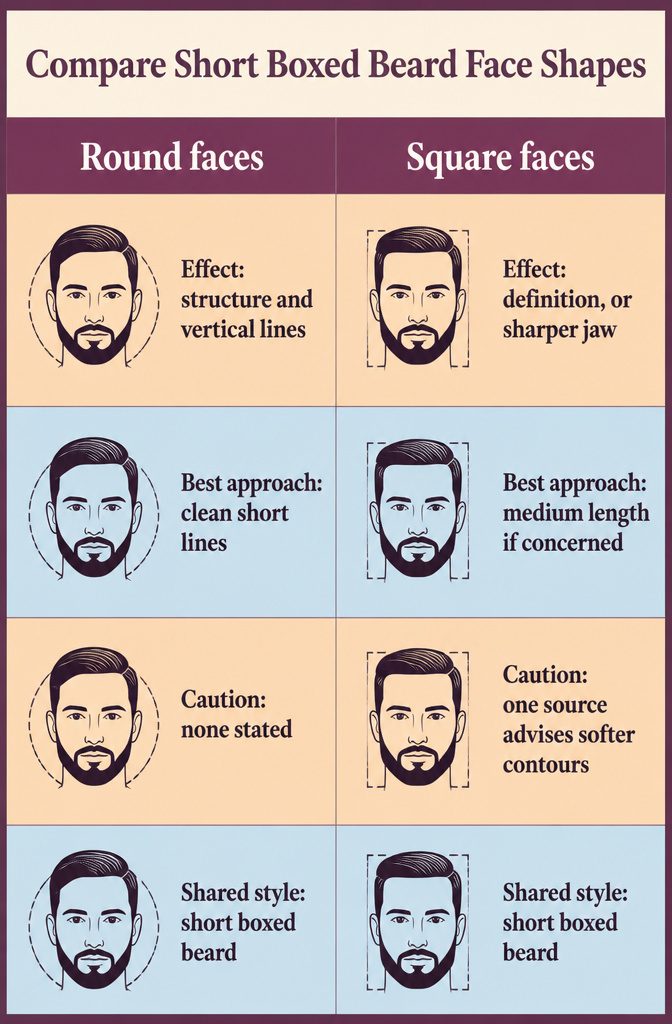
Round, oval, and square faces show up most often in the face-shape lists for this style, though the specifics shift by source.
Round faces gain structure and vertical lines that slim and lengthen; oval faces pick up balance and mild framing without losing proportion; square faces work when the cheek line stays tight and the beard adds definition rather than bulk.
Angular and heart-shaped faces appear in a second set of recommendations, broadening the pool.
One source flags a caution for square faces: avoid the short version and reach instead for softer contours and a fuzzier finish that blends rather than sharpens the jawline.
I’d start by checking whether your face reads as having strong angles or soft width.
If it’s the former, the short boxed style can add definition without overwhelming; if it’s the latter, the clean lines help create structure where there wasn’t much before.
The disagreement on square faces matters most if yours is one, and in that case I’d lean toward medium length over short.
Professional and Casual Settings

The short boxed beard picked up the nickname "corporate beard" for two reasons: controlled length and clean edges.
A sharp cheek line and a tidy neckline sit well with a suit, even in conservative offices where a longer, wilder beard might draw a second look.
It holds up after hours too. At 5–10mm it keeps enough texture to look rugged next to jeans and a plaid shirt, so a dinner date doesn’t call for a different version.
For anyone who goes from a board meeting to a night out, I’d pick it over a full beard. The edges are what keep it professional, and they need touching up about 3–4 times a week.
Short Boxed Beard With Patchy Growth
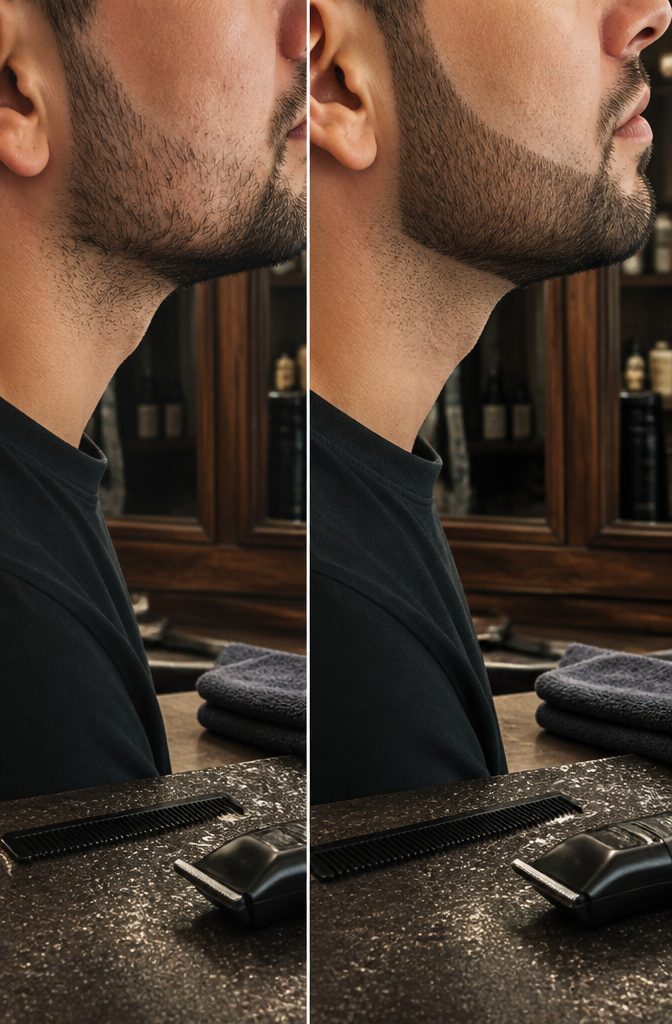
At 5–9mm, there’s little length to reveal gaps, so patches read as shadow instead of bare skin. Growing the beard out to cover them tends to backfire, since the thin spots show through and the shape goes fuzzy.
Put the effort into the edges. Tight, sharp lines make coverage look fuller, and symmetry counts for more than density.
If the gaps sit on your upper cheeks, set the cheek line low: crop it below where the hair naturally grows, down the sideburns to meet at the top of the chin.
That cuts the sparse area out of the shape entirely, and I’d take it over chasing a high line you can’t fill in.
Common Mistakes
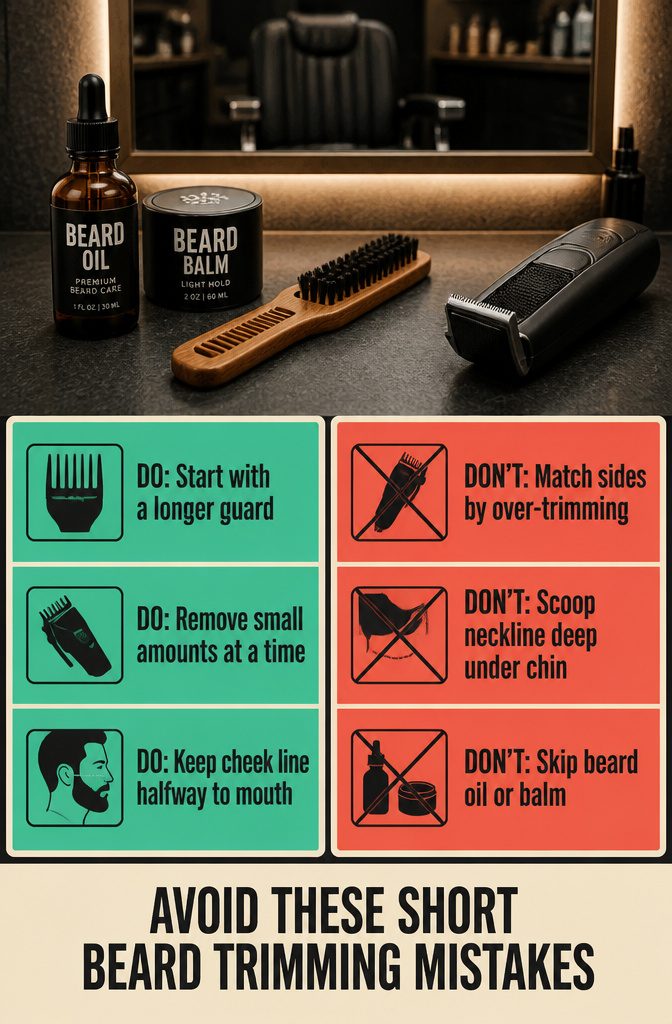
These are the mistakes that wreck a short boxed beard fastest:
- Over-trimming one side to match the other. It leaves the beard lopsided and patchy. Take off small amounts, check the mirror in good light, and start with a longer guard, since length only comes off.
- Setting the cheek line too high. The beard looks sparse and disconnected. I’d rank this worst; keep the line about halfway between the sideburn and the corner of your mouth.
- Scooping the neckline too far under the chin. A boxed beard wants a clean, straight edge, and a deep curve blurs the jawline.
- Skipping beard oil. Dry hair turns wiry and frizzy and fights the shape.
- Skipping balm or lightweight wax. A tiny amount holds the edges, and regular brushing keeps the beard from sagging by afternoon.
Frequently Asked Questions
What length is a short boxed beard?
A short boxed beard sits around 1/2 inch, or 12–15 mm.
Guard settings typically range from 9–12 mm for a balance between definition and texture, though you can go as low as 5 mm for a tighter look or stretch to 15 mm for more volume.
Start longer and trim down, since you can always cut more but can’t add length back.
How often should I trim a short boxed beard?
Trim the full beard every 3–5 days to maintain even length, and touch up the cheek and necklines every 2–3 days to keep the edges sharp.
Slow growers can stretch the length trim to weekly, but the borders still need frequent attention to preserve the boxed shape.
What face shape suits a boxed beard?
Round, oval, square, angular, and heart-shaped faces all work with a short boxed beard.
Round faces gain structure and vertical lines, oval faces get balanced framing, and square faces benefit from the clean definition as long as the cheek line stays tight and the beard doesn’t add excessive bulk.
How long does it take to grow a short boxed beard?
You need at least 2 weeks of growth before shaping, and 4 weeks gives better coverage to work with.
The minimum workable length is about 10–15 mm. First-time growers with lighter or red facial hair should aim for 1–2 inches to fill in patchy spots before trimming.
Is a short boxed beard suitable for professional settings?
Yes.
The controlled length and clean edges make it workplace-friendly, even in conservative offices where longer beards might draw attention. The sharp cheek line and tidy neckline sit well with a suit, which is why it’s sometimes called the corporate beard.
Can I achieve a short boxed beard with patchy growth?
Yes. At 5–9 mm, there’s little length to reveal gaps, so patches read as shadow instead of bare skin.
Put the effort into tight, sharp edges, since clean lines make coverage look fuller. If the gaps sit on your upper cheeks, set the cheek line low to crop the sparse area out of the shape entirely.
Can I combine a short boxed beard with a mustache?
Yes. The mustache should match the beard in length or sit just slightly shorter.
Trim back any hairs that hang over your upper lip, since they break the clean look. A detail trimmer gives better control than a full guard.
What are common mistakes to avoid with a short boxed beard?
Over-trimming one side to match the other leaves the beard lopsided and patchy. Setting the cheek line too high makes the beard look sparse, so keep it about halfway between the sideburn and the corner of your mouth.
Scooping the neckline too far under the chin blurs the jawline, and skipping beard oil turns the hair wiry and frizzy.