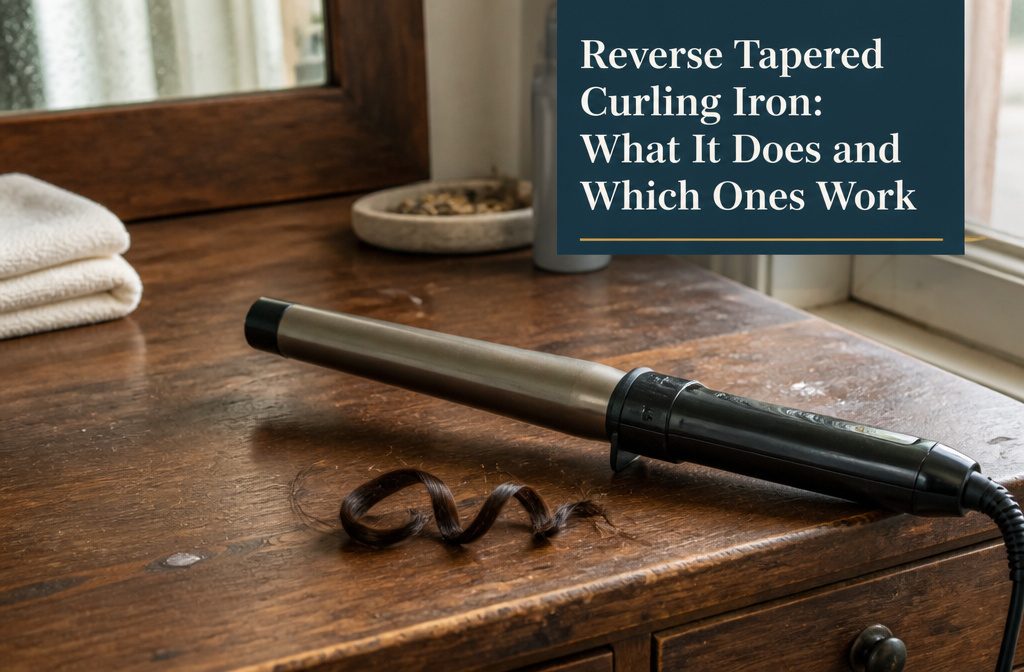
A tapered curling iron is narrow at the tip and widens toward the handle, but a reverse tapered iron flips that: it starts narrow near the handle and gets wider at the end.
That shape lets you wrap roots around the skinny part and tips around the thicker section, which keeps curl tight where hair usually falls flat.
Cynthia Alvarez sprays each section with Dove Flexible Hold before wrapping to help the curl set faster.
What Reverse Tapered Means
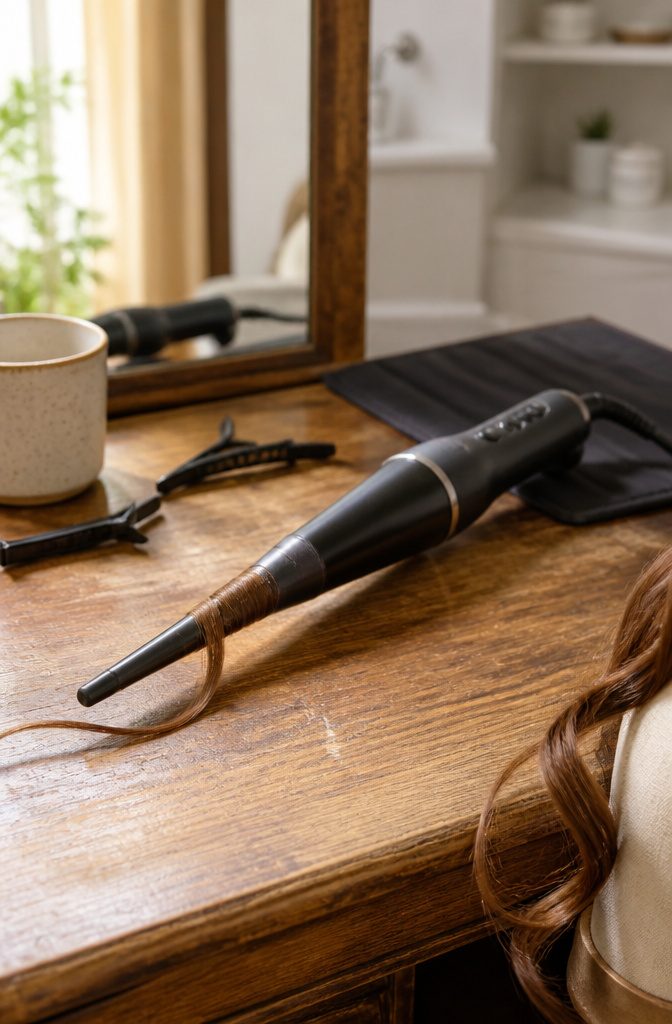
A reverse tapered curling wand is narrow toward the middle and wider at the back end. Picture a lightsaber or the top of a bubble-letter exclamation point: the barrel thickens as it moves away from the handle.
That reversed taper is the opposite of what most traditional curling irons do, where the barrel starts wide near the handle and tapers down toward the tip.
The shape dictates how you wrap hair. Your roots sit near the skinny part of the wand, while the ends of your hair rest against the wider end.
That placement is what gives the tool its volume advantage, keeping curl tight where hair normally falls flat under its own weight.
How I Tested Two Reverse Tapered Irons
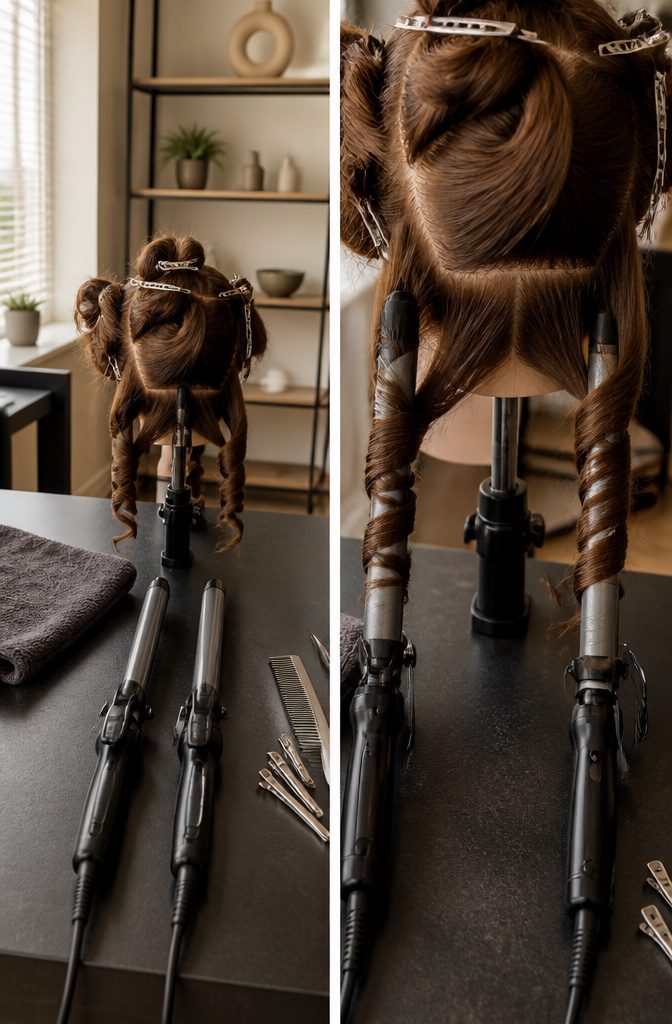
Putting one iron on each side of your head is the fairest way to compare two reverse tapered tools, since hair type, humidity and technique stay the same.
That is the setup for the Bed Head Curlipops Reverse Tapered Styling Iron and the T3 Cascading Waves Iron.
Tie the hair up in sections first, then wrap one section at a time. Eyeball each one at about an inch; that is a rough measure, so expect some variation from curl to curl.
Roots go near the narrow part of the iron and the tips sit at the wide end. I’d keep that orientation identical on both sides so the barrel shape is the only thing that changes.
The Curls I Got and the Burn Risk
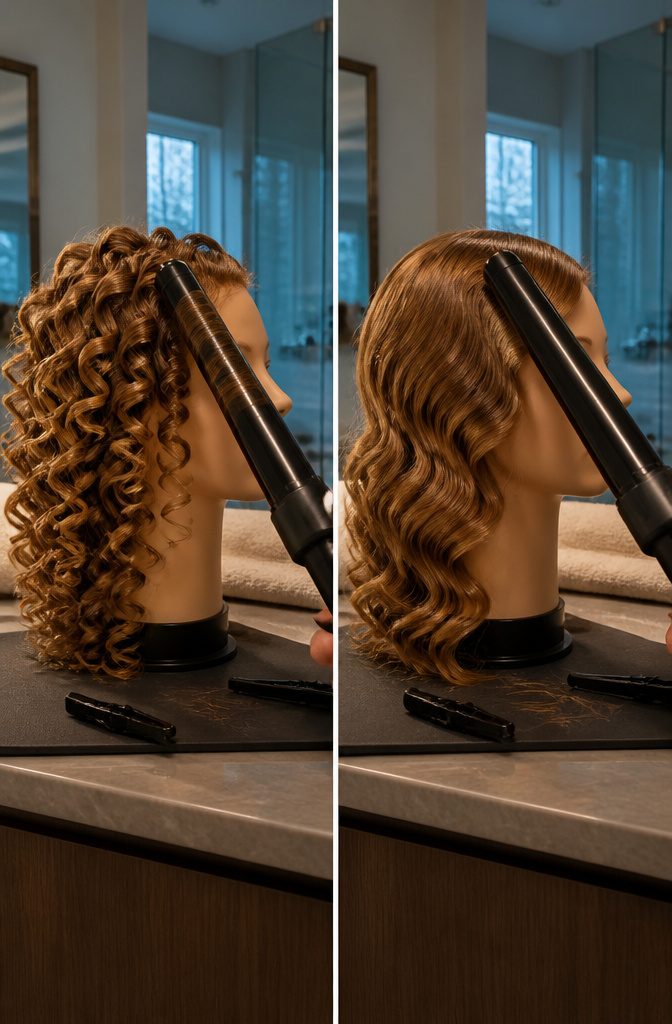
The first pass gave me tight, prom-night ringlets that softened into loose waves over the next hour or so. I liked the second version better, the looser one, but getting there meant waiting out that initial spring.
The handling part bothered me more than I expected. A reverse tapered wand puts the hottest, widest barrel close to your scalp, and your fingers work inches from hot metal the whole time you wrap.
I grazed the barrel twice on the first six curls, once on my knuckle and once on the pad of my thumb.
Neither left a mark, but both made me flinch hard enough that I had to start the section over.
If you curl near your temples or jawline, the wand sits very close to your face, and there is no cool tip to grab.
Why Stylists Say the Shape Adds Volume and Holds Waves Longer
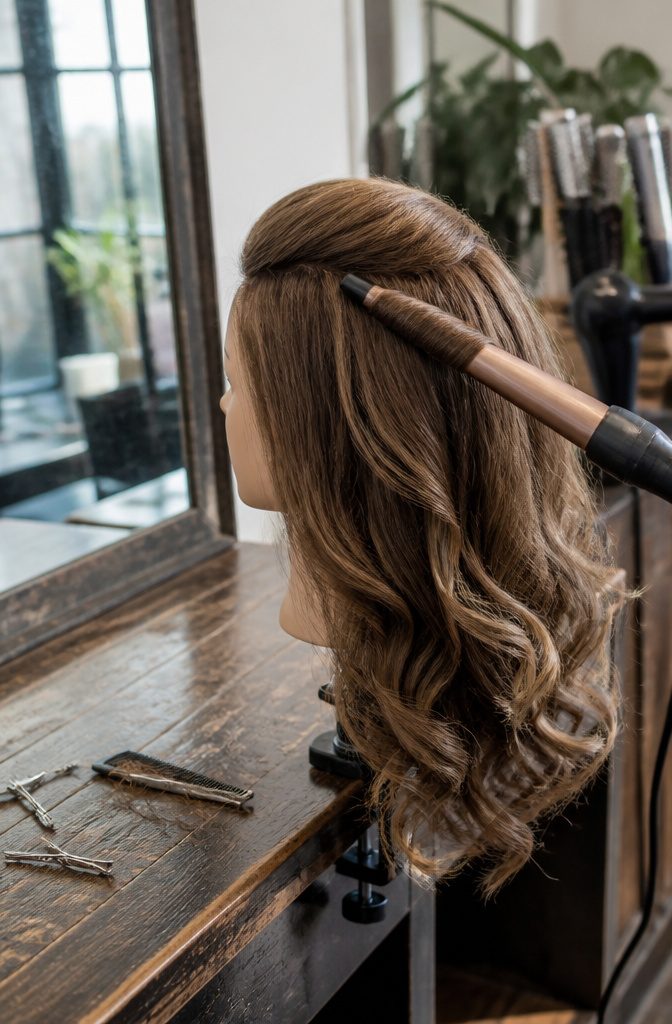
The root is the trouble. Hair at the crown carries the weight of everything below it, and on most people that means the base sits flatter than the rest.
A reverse tapered iron puts its narrowest point where the curl starts, keeping tension where it matters.
Cynthia Alvarez says the shape holds a curl at the root, where straight hair would otherwise flatten under its own weight, and points clients toward the tool when volume is the goal.
Chuck Bass, who styles hair across Boston and New York, frames it differently but arrives at the same place.
If you look at someone with naturally wavy hair, their roots also have a wave or curl, and this type of iron gives you that. It curls the base so hair keeps those soft waves, and for much longer.
— Allure
The hold lasts because the curl sits close to the scalp instead of starting an inch down. Hair that waves from the root looks fuller and stays that way between washes.
Where to Place Your Hair on the Wand
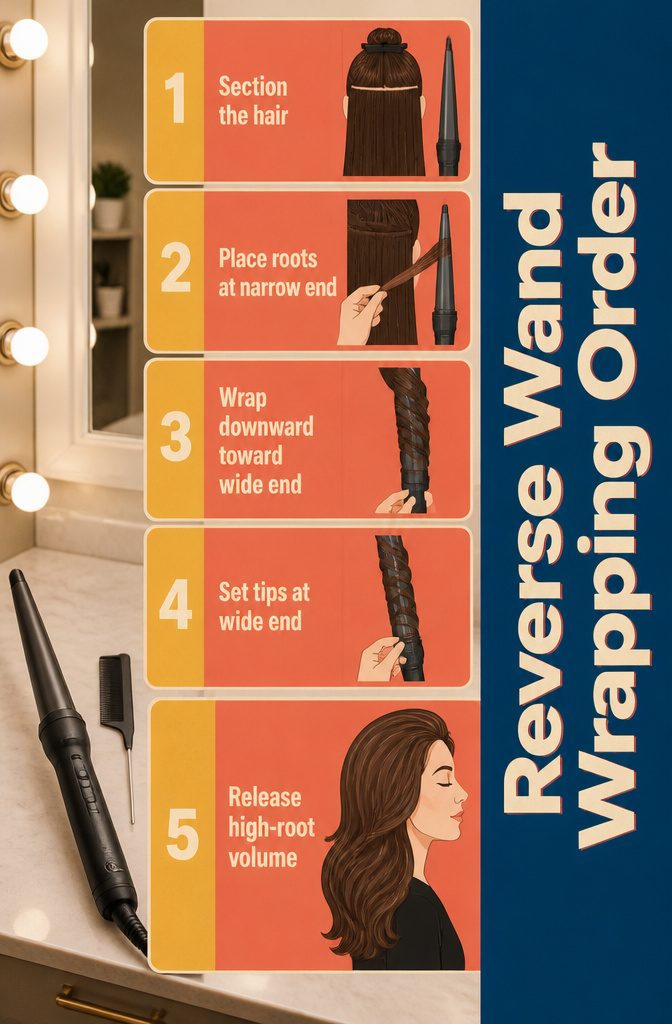
The wrapping direction is backward from what most people expect.
You section the hair, then place the roots near the narrow end of the wand and wrap down so the tips land at the wide end. That reversed placement gives the tool its name and its volume.
The narrow-at-root setup keeps curl tight where it matters. Hair closer to the scalp gets wound around a smaller barrel diameter, so it springs tighter and holds longer before gravity pulls it straight.
The tips, wrapped around the wider section, end up looser and softer. The result reads as volume that starts high rather than ringlets that taper to nothing.
The downside is proximity. Wrapping roots first means the hot barrel sits closer to your face and scalp than it does with a standard wand, and your fingertips spend more time near hot metal while you’re placing each section.
The angle takes getting used to.
The Curl and Volume You Can Expect
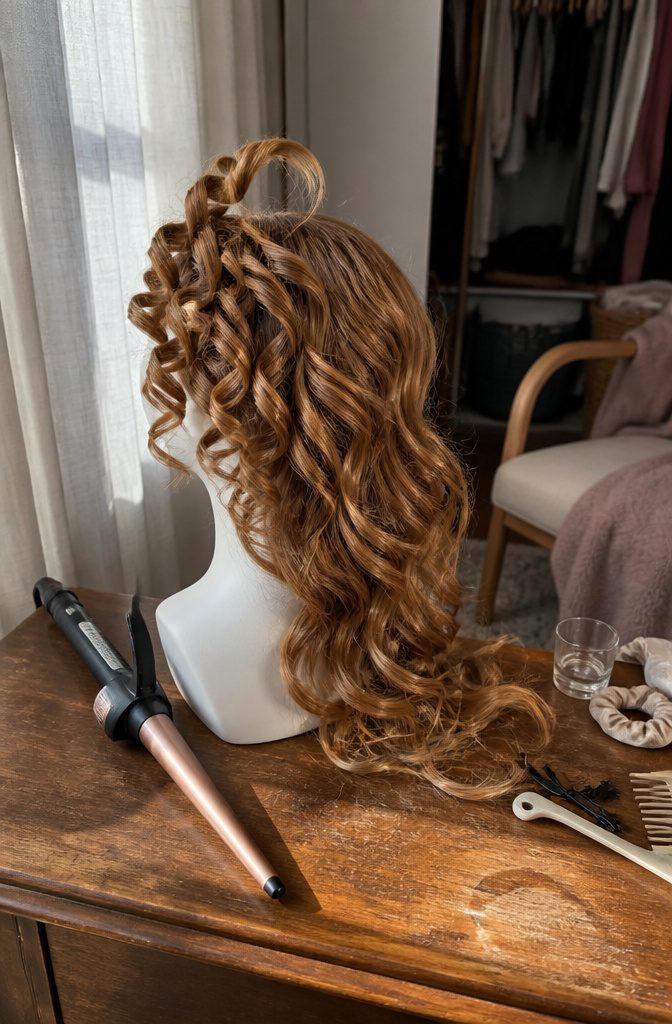
The iron gives you tight ringlets that relax into loose, lived-in curls after a few hours.
That drop is built into how it works: the taper pulls hair tighter near the base, so curls start snug and soften as they settle.
The result reads as naturally wavy rather than set, because the curl starts at the root and carries through the length instead of leaving the first two inches flat.
Volume sits where it shows. The taper grabs hair close to the scalp and lifts it away from the head as it curls, so you get root lift without backcombing or product.
Waves hold longer than they do off a straight barrel, and the base curl keeps hair from falling flat by mid-afternoon. If your hair typically loses shape an hour after styling, this is the tool that changes that.
One Stylist’s Hairspray Habit
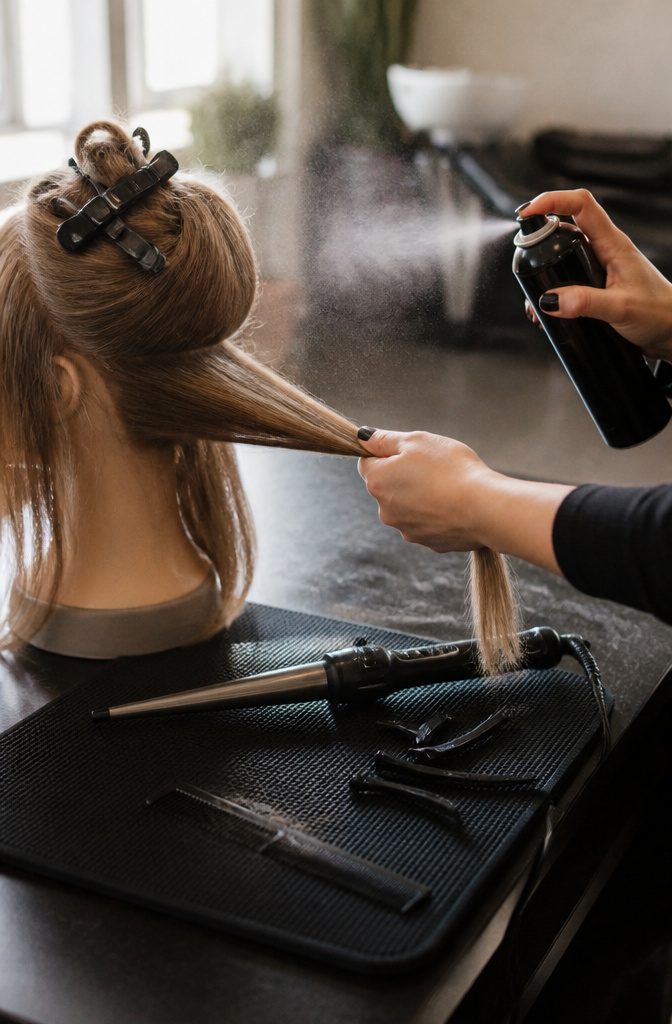
Cynthia Alvarez, a stylist who works with the reverse tapered iron regularly, spritzes each section with Dove Flexible Hold Hairspray before wrapping hair around the barrel.
She says the prep step helps the curl set faster and hold longer once the iron comes off.
I have not run a controlled test with and without hairspray to measure the difference in hold time, so what I can report is her stated practice rather than a measured result.
The logic tracks: hairspray applied before heat gives the product a chance to set as the barrel warms the hair, locking shape in at the same time the curl forms.
Whether that advantage is large enough to justify the extra step will depend on how well your hair holds a curl without it.
Which Iron Performed Better in the Side-by-Side Test
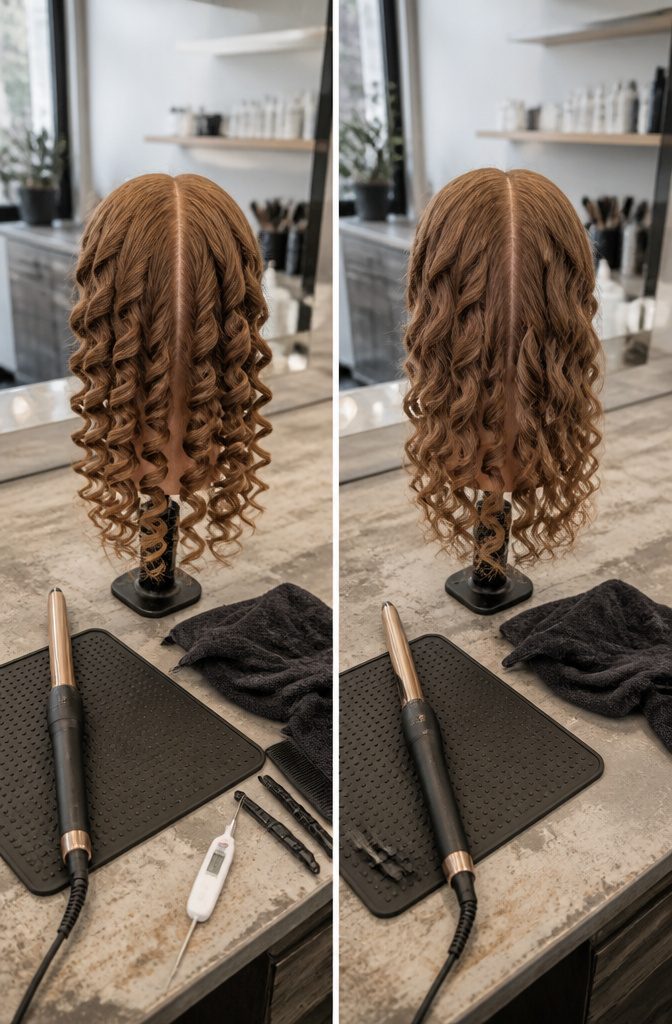
The side-by-side test showed that both irons produced tight curls at first that dropped into loose waves over time, but the writer never reported which iron held the curl better, gave more volume, or made styling easier.
She used the Bed Head Curlipops on one side and the T3 Cascading Waves on the other, yet the results are described collectively rather than compared.
That leaves the most practical question unanswered: if you’re choosing between two reverse tapered irons, does one deliver noticeably better lift at the root or longer-lasting shape than the other?
What did come through is the burn risk near the face and the need to place roots at the narrow end of the barrel.
If you’re deciding between models, look for heat settings, barrel diameter range, and whether the handle angle keeps the hot metal farther from your temple when you wrap hair close to the scalp.
Frequently Asked Questions
Which tapered curling wand is the best?
Both produced tight ringlets that relaxed into loose waves over a few hours. When choosing between reverse tapered irons, check for adjustable heat settings, barrel diameter range, and a handle angle that keeps hot metal farther from your scalp.
How do you use a tapered curling iron?
Place the roots of each section near the narrow end of the wand and wrap downward so the tips land at the wide end.
That reversed placement keeps curl tight where it matters and gives you volume at the root instead of leaving the base flat.
The narrow part sits closer to your scalp than a standard wand does, so expect the hot barrel to work near your face and fingertips while you wrap.
What is the difference between a straight and a tapered curling wand in terms of curl?
A reverse tapered wand puts its narrowest point at the root, where hair normally falls flat under its own weight, so curls stay tight near the scalp and hold longer.
A straight barrel wraps hair at the same diameter from root to tip, which gives you uniform curl but less volume at the base.
The tapered shape delivers waves that start high and soften toward the ends instead of springy ringlets that drop flat after an hour.
Which curling iron is least damaging to my hair?
What does matter is using a heat protectant before any hot tool, starting at the lowest temperature and raising it only as needed, and working on completely dry hair. Those steps reduce damage regardless of which iron you choose.