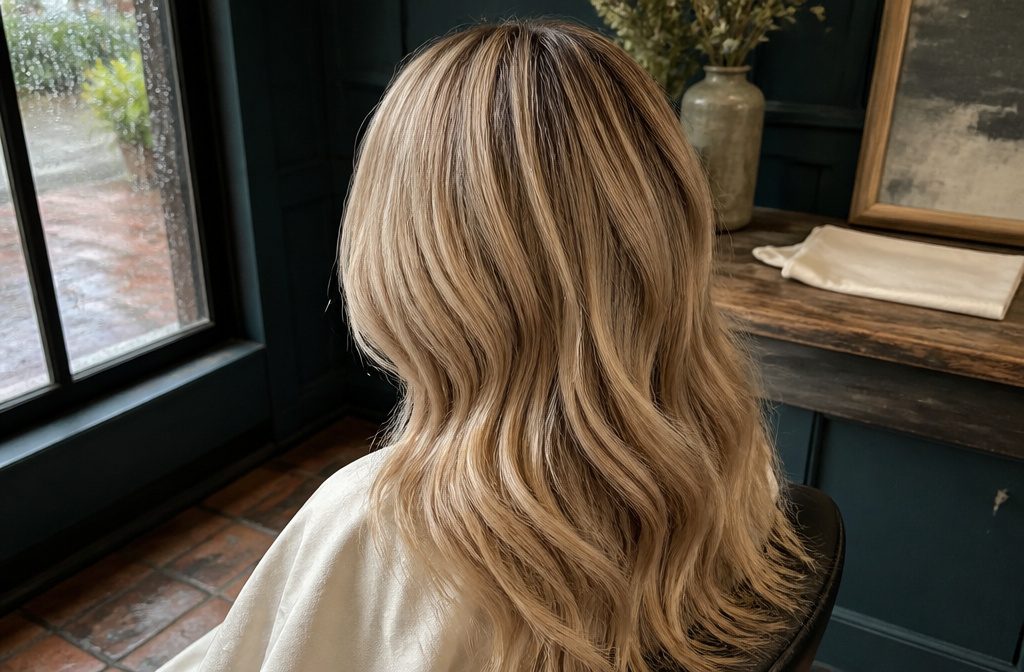
Dimensional blonde blends two or three tones so the color looks layered and catches light as you move.
It only works if the shades sit 2–3 levels apart: closer reads flat, and much wider looks striped, especially on fine hair. Babylights, balayage with a shadow root, and highlights with lowlights each get there differently.
What Dimensional Blonde Is and Why It Works
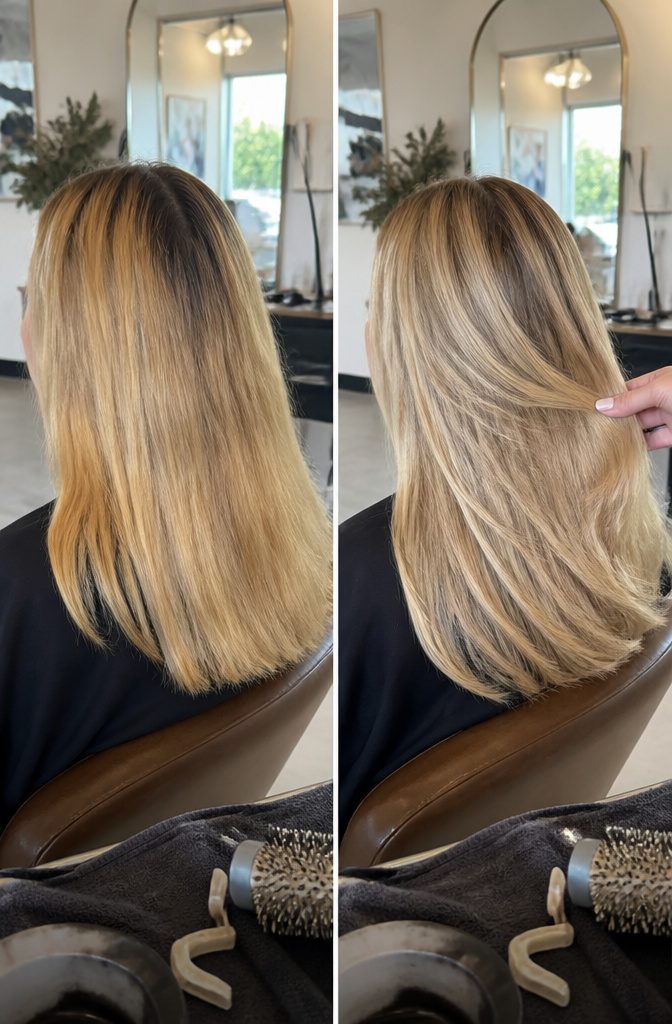
Solid blonde is one shade from root to tip. Dimensional blonde blends two or three tones, placed so the color looks layered and catches light from different angles as you move.
Aim for a 2–3 level difference between the lightest and deepest tones.
Closer than that and the color reads flat. Much wider and it starts to look striped, which shows up fastest on fine hair, so I’d stay at the narrow end of the range there.
Movement is the other result. The shades sit close enough to blur into each other, so the hair seems to shift as it swings.
The regrowth line also softens instead of showing as a hard band, and a single flat shade has nowhere to hide that line.
Why Blonde Looks Flat or Uneven
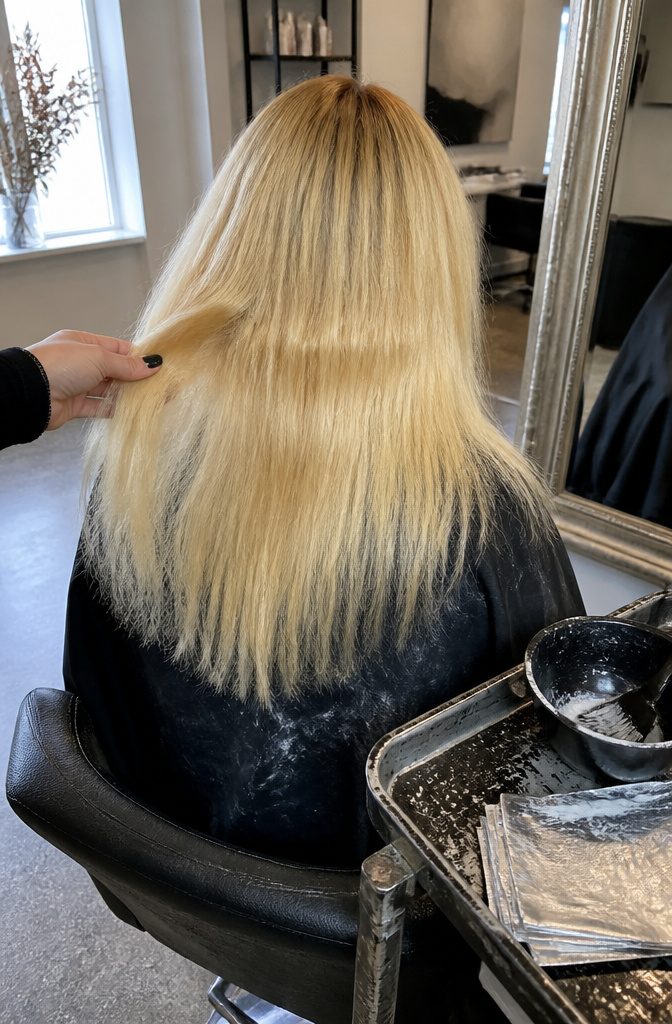
Blonde turns flat when everything is lifted to the same level and covered with the same tone.
That happens when lightener is applied to the entire head with a single developer volume, processed for the same amount of time in every section, then finished with an opaque toner that paints over any variation that might have survived.
The result is a uniform pale shade with no shadow to give the light areas contrast, and nothing for the eye to register as depth.
Overlapping lightener on previously lightened hair pushes the problem further. The ends end up paler than the rest, often to a uniform straw yellow, while the roots stay warmer or darker.
Fading makes it worse. Toner washes out unevenly and leaves the hair looking one-note yellow or washed out, sometimes with visible banding where one pass of lightener met another.
Uneven processing causes its own version: sections that lifted faster or slower than the rest, so the blonde reads as patchy rather than blended.
Highlights With Lowlights for Visible Contrast
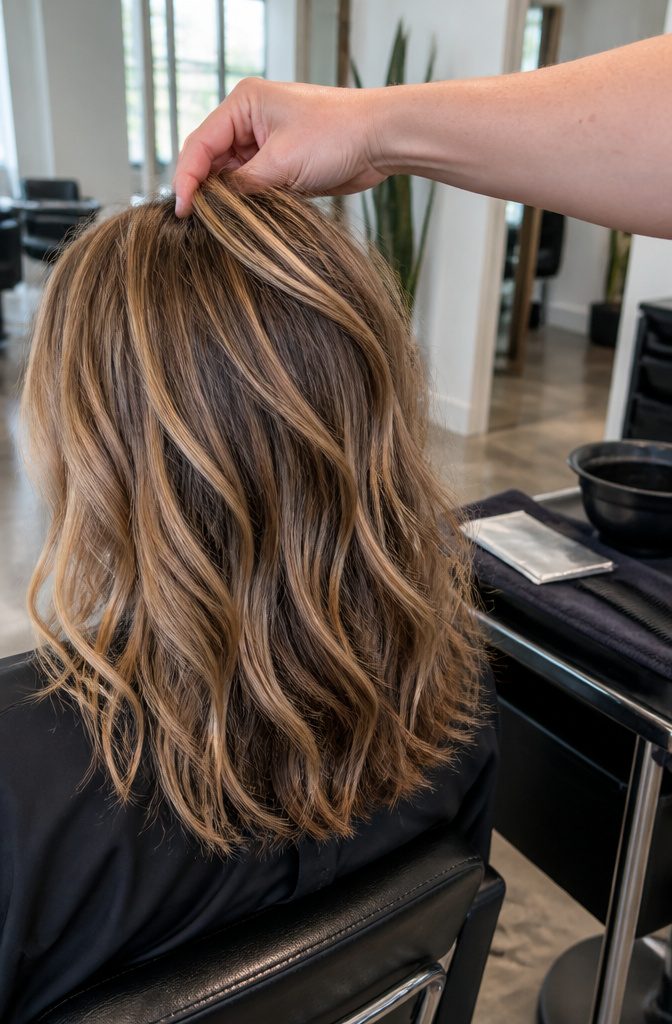
Highlights lift selected strands lighter while lowlights add strands slightly darker, and the pairing is the most direct fix for blonde that reads as one solid block.
Highlights go where light naturally falls: the hairline, part, crown and ends. Lowlights are woven underneath or through the back and sides, usually 1–2 levels deeper than the base, so the darker tone reads as shadow rather than stripes.
I pick this method for brunettes and dark blondes who want contrast people can actually see.
It also suits blonde that already looks heavy or flat, because it adds definition without lifting more hair than necessary. Book touch-ups every 8–12 weeks to keep the pattern crisp.
Babylights for a Subtle Blend
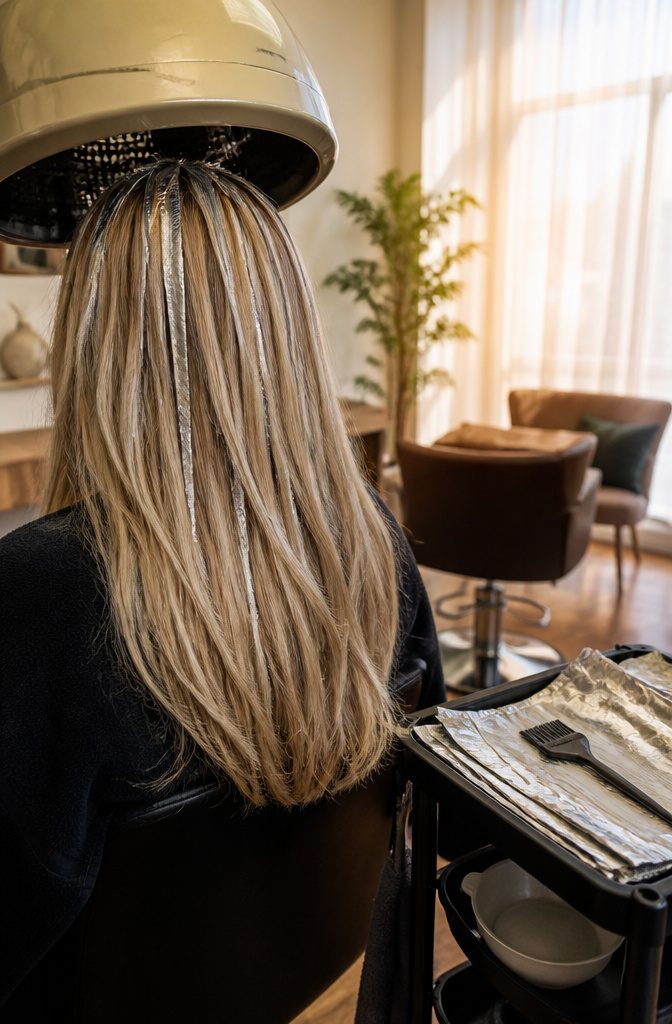
Babylights are very fine, foil-woven highlights that give a subtle, shimmery blend rather than obvious contrast.
The placement mimics the way sun naturally lightens hair, so the result reads as soft dimension instead of stripes. I think of them as the gentlest way to add movement to blonde without announcing that anything was done.
Fine hair benefits the most. Contrast makes it look fuller, and babylights deliver that without the heavy sectioning that can leave thin hair looking sparse between highlights.
Keep the level difference closer to 2 rather than pushing for dramatic lift, and stick with lower developer volumes to protect the hair. You get dimension that catches light without weighing down or overprocessing what you started with.
Touch-ups land every 10–14 weeks. That frequency keeps the blend smooth as new growth comes in, and because the highlights are so fine, regrowth tends to soften rather than stripe.
The upkeep commitment sits between single-process blonde and bolder balayage, close enough to natural that you can stretch an appointment a week or two if needed.
Shadow Root With Balayage for a Lived-In Result
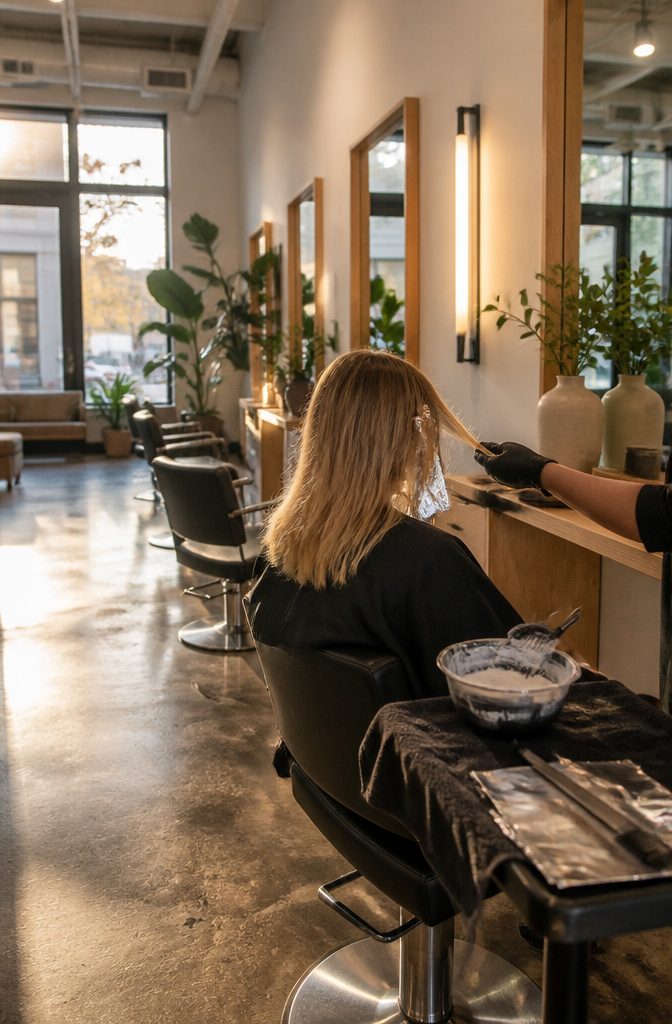
A shadow root deepens the first inch or two at the scalp by one to two levels, then melts into hand-painted balayage through the mid-lengths and ends.
The darker base gives the lightest pieces more contrast to work against, so the blonde reads richer instead of flat.
Balayage sweeps the lightener on in a softer motion than foil, which keeps the transition gradual and avoids hard lines where the root color stops.
Regrowth blends into the shadow instead of announcing itself as a stripe, so you can stretch touch-ups to twelve to sixteen weeks without looking overdue.
That makes this the lowest-maintenance route to dimensional blonde if you want a lived-in, sun-kissed result. The effect shows on any length, but medium to long hair gives the blend more room to develop.
Foilayage for Brighter Lift With Blending
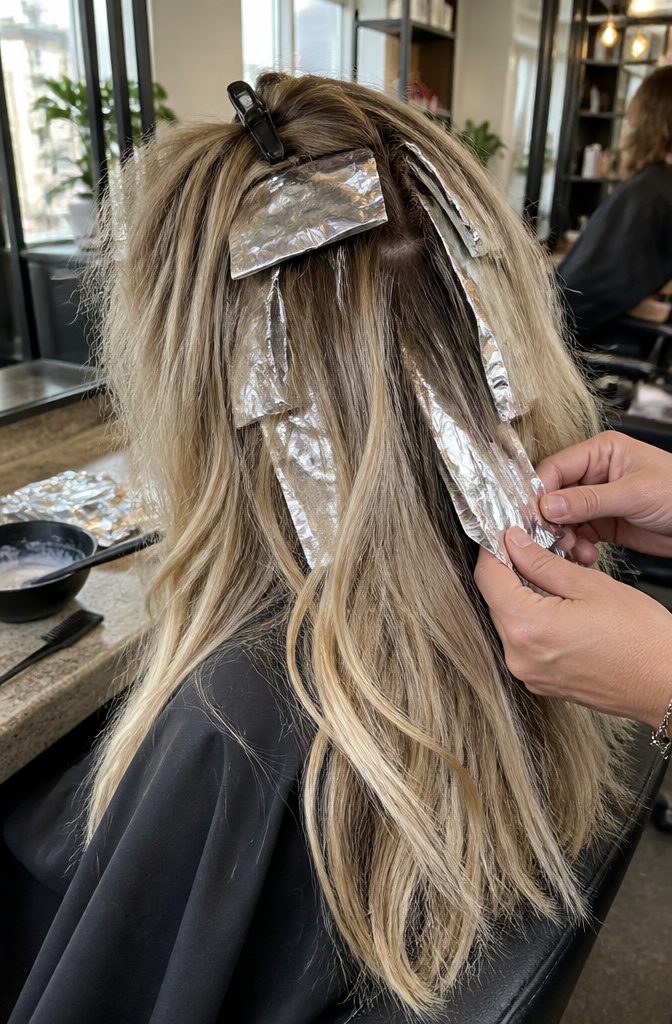
Foilayage for Brighter Lift With Blending
Foilayage takes balayage technique and paints it onto foils instead of leaving the color open to air.
The foil traps heat and pushes the lightener further, so you get brighter lift than balayage alone while keeping the soft, blended finish that freehand placement gives you.
It sits between full foils and pure balayage: more control than painting in open air, less harsh than a grid of foils spaced evenly from root to ends.
I think of it as a hybrid move rather than one of the three core methods.
It borrows the control of foils and the softness of balayage, and it works when you want more contrast than babylights can deliver but still need the color to fade without a hard line.
The foil gives you the lift, the balayage placement gives you the blend.
Balayage Against Foiling
Balayage Against Foiling
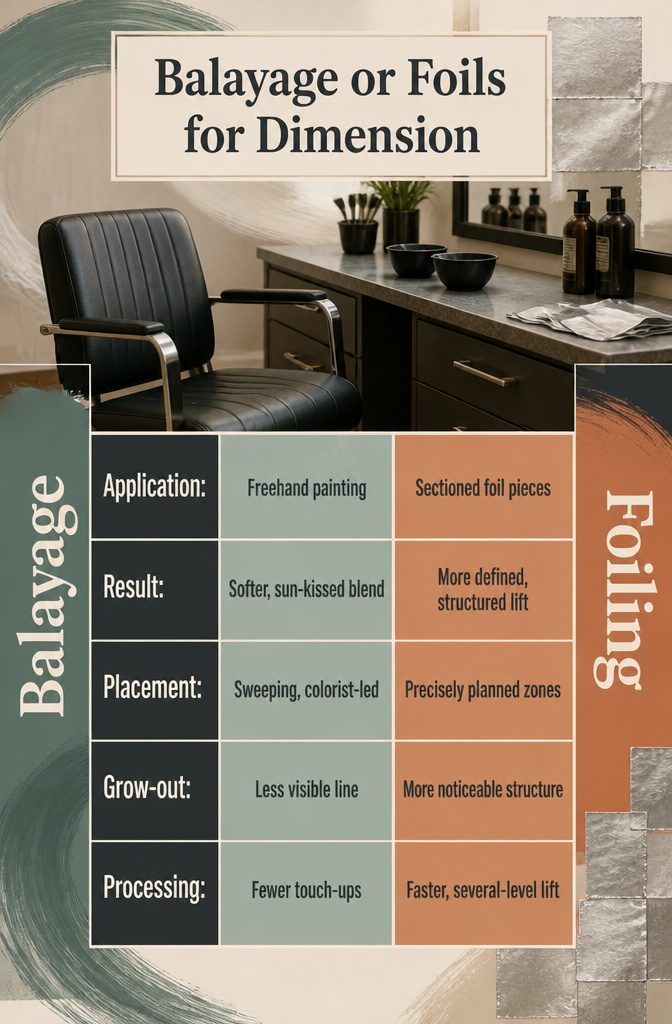
Balayage is freehand painting applied in sweeping strokes where the colorist wants lift, which gives softer transitions and a look that grows out without an obvious line.
Foiling segments the hair into sectioned pieces wrapped in foil, so the placement is more controlled and the lift more defined.
The freehand method lands lighter at the ends and blends through the mid-lengths, which reads as sun-kissed rather than striped.
Foiling gives you precision: if you want highlights that start higher or sit in specific zones, the sectioned approach puts them exactly where you drew the plan.
Balayage wins for a lived-in result that needs fewer touch-ups. Foiling wins when you want structure or need to lift several levels in one session, since the foil traps heat and accelerates processing.
How to Formulate and Place the Color
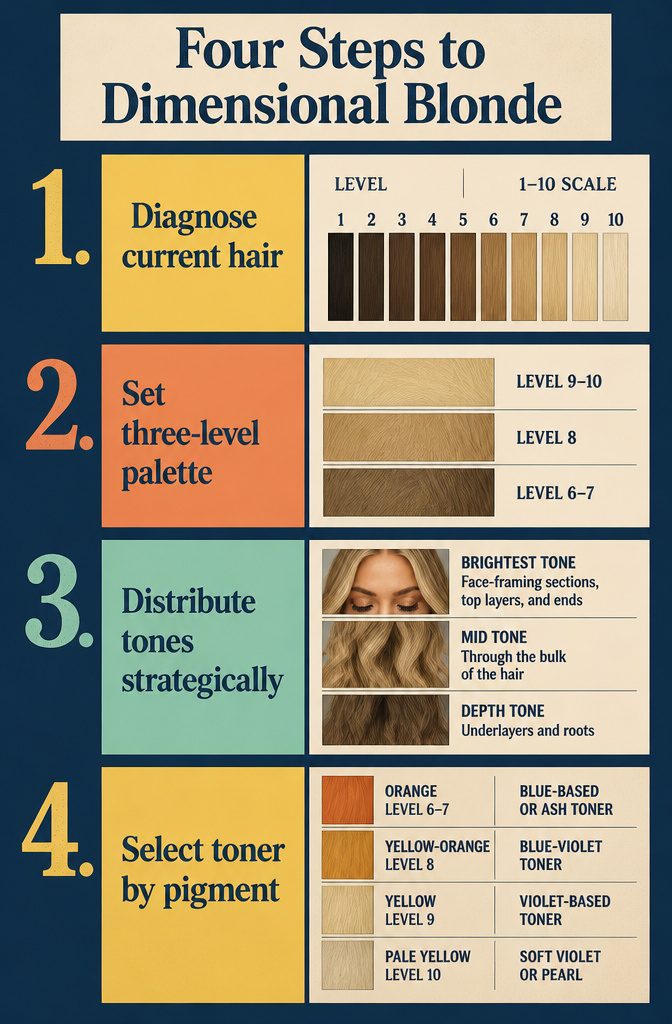
- Diagnose the hair as it is now. Check the level range on a 1–10 scale: flat blonde usually spans less than one level, and you need at least two levels of contrast to read as dimensional. Look at condition, especially dryness or breakage on previously lightened ends. Note any color build-up, box dye, or henna that can lift unpredictably. Identify the underlying pigment: does the hair lighten to orange, yellow-orange, yellow, or pale yellow? That dictates which toner you’ll need later.
- Set a palette with three levels. The brightest tone sits at level 9–10 and frames the face. The mid tone lands at level 8. The depth tone drops to level 6–7 and anchors the dimension. Decide which tones to use based on skin tone and whether you want cool, neutral, or warm blonde.
- Distribute the tones. Place the brightest pieces where light hits: face-framing sections, top layers, and ends. Use the mid tone through the bulk of the hair. Reserve the depth tone for the underlayers and roots. The placement matters more than the formula; scattering depth randomly flattens the result.
- Select toner by underlying pigment. Orange around level 6–7 needs a blue-based or ash toner. Yellow-orange at level 8 takes blue-violet. Yellow at level 9 wants violet-based toner. Pale yellow at level 10 gets soft violet or pearl. Use a sheer or translucent formula, and consider two different toners: a cooler one on the brightest sections, a softer warmer tone on the deeper ones, so the contrast stays visible after toning.
How to Correct Flat or Uneven Blonde
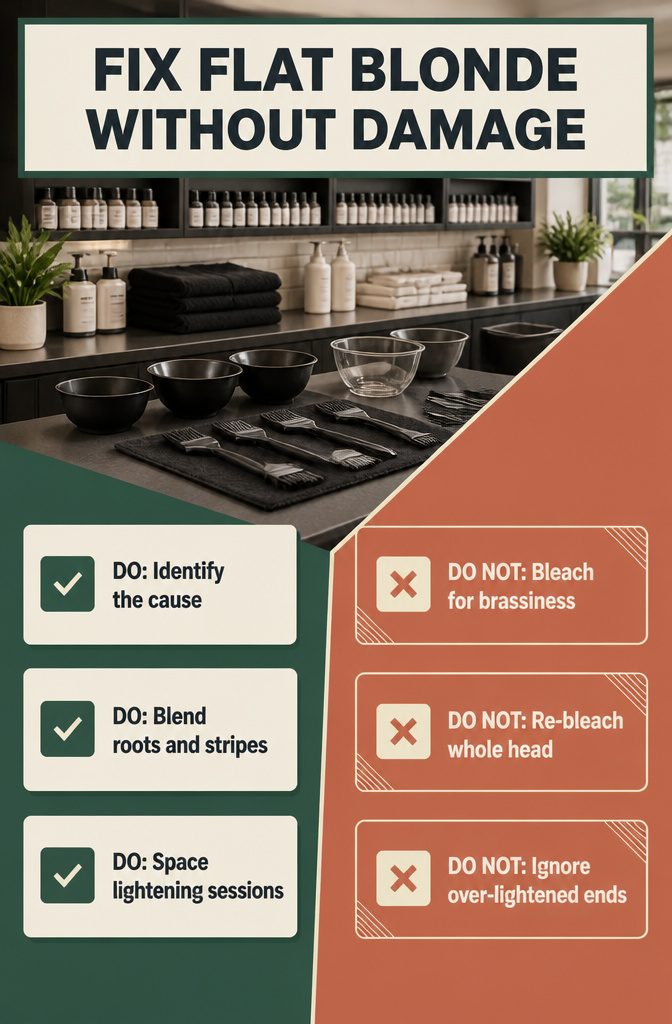
The first move is to identify the cause, because the fix changes depending on whether the problem is brassiness, dark roots, visible stripes, over-lightened ends, or muddy grey tones. Each reads differently and responds to a different approach.
Brassiness calls for targeted toning rather than more bleach. Dark roots can be blended with a root smudge or a gloss that matches the mid-tones, paired with fine babylights to visually break up any hard line.
Stripes or banding happen when lightener was pulled through previously lightened hair; the fix is the same as for roots, blending rather than re-lifting.
Over-lightened ends need color deposited back in, usually with a gloss or lowlights placed selectively. Muddy or grey tones mean the underlying pigment needs correction, often with a different toner formula.
Space lightening sessions out so the hair can recover between rounds. You always want to avoid re-bleaching the whole head.
How to Choose a Flattering Blonde
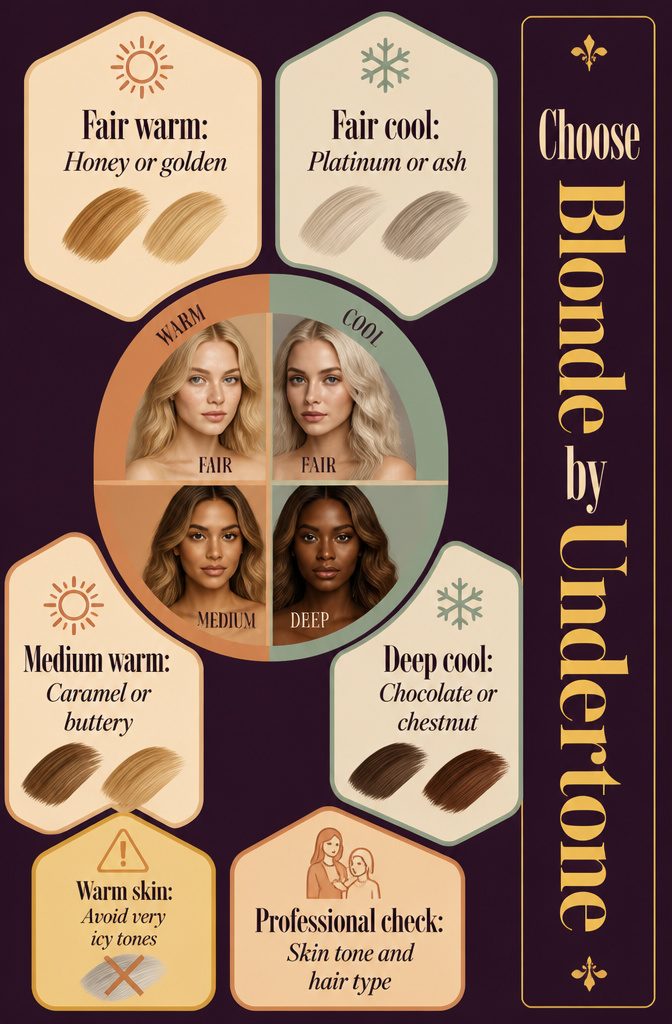
Fair skin with warm undertones suits honey or golden blonde, while fair skin with cool undertones does better with platinum or ash. On medium skin, warm undertones pair with caramel or buttery shades and cool ones with beige or sandy.
Deep warm skin takes honey or caramel, and deep cool skin looks best in chocolate or chestnut. I’d keep very icy tones away from warm skin, where they can look washed out.
Trend shades follow the same logic. Butter and honey with lowlights run warm, champagne and icy blonde with a shadow root run cool, and bronde flatters olive skin.
Undertone is hard to judge alone, so have a professional colorist check your skin tone and hair type before committing.
How to Maintain the Result
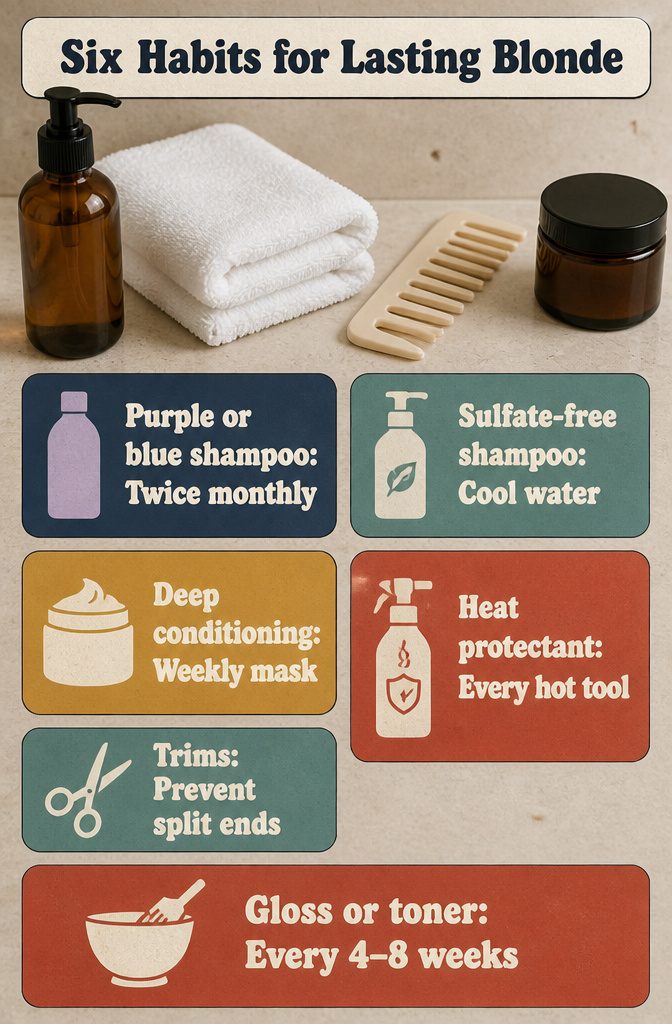
Six habits keep the tones balanced, and the gloss schedule is the one people skip.
- Purple or blue shampoo: twice a month is enough for most blondes. If yours turns warm fast, I’d use it weekly or as needed.
- Sulfate-free shampoo: it helps preserve toner. Wash with cool water and don’t over-wash, since both slow fading.
- Deep conditioning: use a mask weekly for moisture. Add a bond-repairing treatment to keep lightened strands strong.
- Heat protectant: apply it before any hot tool, every time.
- Trims: regular ones prevent split ends, and the dimension stays easy to see.
- Gloss or toner: refresh it every 4–8 weeks to rebalance tone and bring back shine between color appointments.
Frequently Asked Questions
How do you make dimensional blonde hair?
Blend two or three blonde tones that sit 2–3 levels apart, with the deepest tone at the roots or underlayers and the lightest pieces where light naturally hits.
Three techniques get you there: highlights with lowlights, babylights, or a shadow root with balayage. Which one fits depends on how much contrast you want and how often you’ll visit the salon.
How do you formulate a dimensional blonde step by step?
Start by checking the hair’s current level range, its condition, any build-up, and the underlying pigment. Next, set a three-tone palette: level 9–10 for face-framing brights, level 8 for the mid tone, and level 6–7 for depth.
Place the brightest pieces where light falls, the mid tone through most of the hair, and the depth tone underneath. Finish with a sheer toner chosen for the underlying pigment.
What mistakes flatten blonde hair and how do you avoid them?
The most common are lifting the whole head with one developer volume, processing every section for the same time, and covering it all with an opaque toner.
Re-lightening hair that was already lightened also leaves pale ends and banding. Vary the lift by section, add lowlights for shadow, keep lightener off previously lightened lengths, and pick a sheer toner based on the underlying pigment.
How do you fix uneven blonde hair?
Find the cause first, because each problem has a different fix. Brassiness needs targeted toning, dark roots need a root smudge or gloss with fine babylights, and over-lightened ends need color deposited back with a gloss or selective lowlights.
Banding is blended rather than re-lifted. Avoid bleaching the whole head again.
What is the most attractive blonde hair color?
No single blonde wins, because the flattering shade depends on your skin tone and undertone.
Fair warm skin suits honey or golden, fair cool skin suits platinum or ash, and medium skin does well in caramel or buttery shades if warm and beige or sandy if cool.
A colorist can check your undertone before you commit.
What is the difference between cool blonde and warm blonde, and what are the main shades?
Warm blondes lean golden: honey, butter, caramel, and golden blonde. Cool blondes lean ashy or pale: platinum, ash, champagne, and icy blonde.
Match warm shades to warm undertones and cool shades to cool ones, since very icy tones can look washed out on warm skin. Bronde, a blend of blonde and brown, flatters olive skin.
What is the difference between dimensional blonde and solid blonde, and how many levels apart should the tones be?
Solid blonde is one shade from root to tip, while dimensional blonde blends two or three tones so the color looks layered.
Keep the lightest and deepest tones 2–3 levels apart. Closer than that reads flat, and much wider can look striped.
Does dimensional blonde hair work on fine hair?
Yes, and fine hair often gains the most because contrast makes it look fuller.
Use ultra-fine babylights, keep the level difference closer to 2, and choose lower developer volumes with lighter lifting to protect the hair. A wide gap between tones shows up as stripes fastest on fine strands.
How often does dimensional blonde need touching up?
It depends on the technique.
Highlights with lowlights need a visit every 8–12 weeks, babylights every 10–14 weeks, and a shadow root with balayage every 12–16 weeks. A gloss or toner refresh every 4–8 weeks keeps the tone balanced between color appointments.
Can you convert a flat blonde to dimensional in one session?
Often, yes, if the hair is healthy and already light.
Damaged hair, hair that is very light already, or hair loaded with color build-up may need two sessions so it isn’t pushed too far. Your colorist can judge this after checking the condition of the ends.
How do you maintain dimensional blonde and keep it from turning brassy?
Use purple or blue shampoo about twice a month, or weekly if your blonde warms up quickly.
Wash with cool water, choose a sulfate-free shampoo, and don’t over-wash. Add a weekly deep conditioning mask with a bond-repair treatment, apply heat protectant before every hot tool, and refresh with a gloss or toner every 4–8 weeks.
Is dimensional blonde better for growing out roots?
Yes.
A deeper root blended into lighter lengths softens the regrowth line instead of leaving a hard band. With a shadow root and balayage, you can stretch touch-ups to 12–16 weeks without looking overdue.
Can dark hair achieve dimensional blonde?
Yes, but it may take more than one session to limit damage and brassiness.
Highlights with lowlights work well for brunettes and dark blondes who want contrast people can see. Spacing the lightening sessions out gives the hair time to recover between rounds.
What is the difference between babylights and balayage?
Babylights are very fine, foil-woven highlights that give a subtle, shimmery blend.
Balayage is painted on by hand in sweeping strokes for a softer, more lived-in look. Babylights usually need touch-ups every 10–14 weeks, while balayage paired with a shadow root can go 12–16 weeks.
What is the difference between balayage and dimensional color?
Balayage is a technique, a freehand way of painting lightener onto the hair.
Dimensional color is the result: a multi-tone look with depth and contrast. Balayage, foiling, and babylights can all produce it.